A customer calls after 6 p.m. to find out whether a prescription refill is ready. Another needs to reschedule an appointment for the following day. By the time the business returns their calls the next morning, both customers may have already contacted a competitor.
This is the kind of everyday service gap an AI voice agent is designed to address.
An AI voice agent is software that can answer or make phone calls, understand requests expressed in natural language, and carry out specific tasks. It might answer a common question, book or reschedule an appointment, check an order status, or retrieve information from a company’s internal systems. Unlike a traditional automated phone menu, it does not rely on callers selecting from a fixed list of options.
This guide looks beyond the marketing claims surrounding voice AI. It explains what AI voice agents can realistically do, where their limitations lie, and how businesses can decide whether building one is a worthwhile investment. First, let’s clarify what an AI voice agent actually is in practical business terms.
What Is an AI Voice Agent?
In practical terms, an AI voice agent is software that can handle a phone conversation on behalf of a business. It listens to the caller, understands what they are trying to achieve, and responds with relevant information or completes an action in a connected system.
This is fundamentally different from a traditional phone menu. An IVR system typically relies on fixed options, key presses, or a limited set of phrases such as “billing” or “support.” When a caller phrases a request in an unexpected way, the system often fails to understand it.
An AI voice agent is more flexible in three important ways.
First, it can interpret open-ended speech rather than match every request to a predefined command. A caller can simply say, “I need to move my Tuesday appointment to next week,” without navigating several menu options.
Second, it can retain context throughout the conversation. Once a caller has provided an account number or explained the reason for calling, the agent can use that information later instead of repeatedly asking for it.
Third, when integrated with the right business systems, it can access real-time information and complete approved tasks. This might include checking an order status, retrieving an account balance, finding an available appointment, or updating a booking. It does more than play a recording or read from a static script.
That ability to understand natural language, maintain context, and act within defined business rules is what separates an AI voice agent from a traditional recorded system or a basic scripted bot.
Most AI voice agent solutions rely on six core components: speech recognition, a language-understanding layer, approved knowledge sources, integrations with existing business systems, speech generation, and escalation rules that determine when a conversation should be transferred to a human. Platforms such as Google Dialogflow CX, for example, use structured conversation flows and data extraction to help interpret requests and guide the interaction.
You may also see these systems described as voice AI agents, AI phone agents, or conversational AI voice agents. The table below explains the practical differences between an AI voice agent, a basic voice bot, and a traditional IVR system.
AI Voice Agent vs IVR, Chatbot, and Human Agent
| Solution | Interaction style | Flexibility | Can perform actions | Availability | Best suited for |
| Traditional IVR | Key presses or short fixed phrases | Low — fixed decision tree | Limited, usually routing only | 24/7 | Simple routing and account lookups with clear menu paths |
| Text chatbot | Typed conversation, web or app | Moderate — handles varied phrasing in text | Yes, if integrated with backend systems | 24/7 | Web/app self-service and FAQs where typing is convenient |
| AI voice agent | Spoken, open-ended phone conversation | Moderate to high, depending on scope | Yes, within approved integrations and permissions | 24/7, including after hours | Repetitive phone tasks: booking, status checks, qualification |
| Human agent | Spoken, fully adaptive conversation | Highest — full judgment and empathy | Yes, including exceptions and discretion | Limited to staffed hours and capacity | Complex, sensitive, or high-stakes conversations |
How an AI Voice Agent Handles a Call
The call flow, step by step
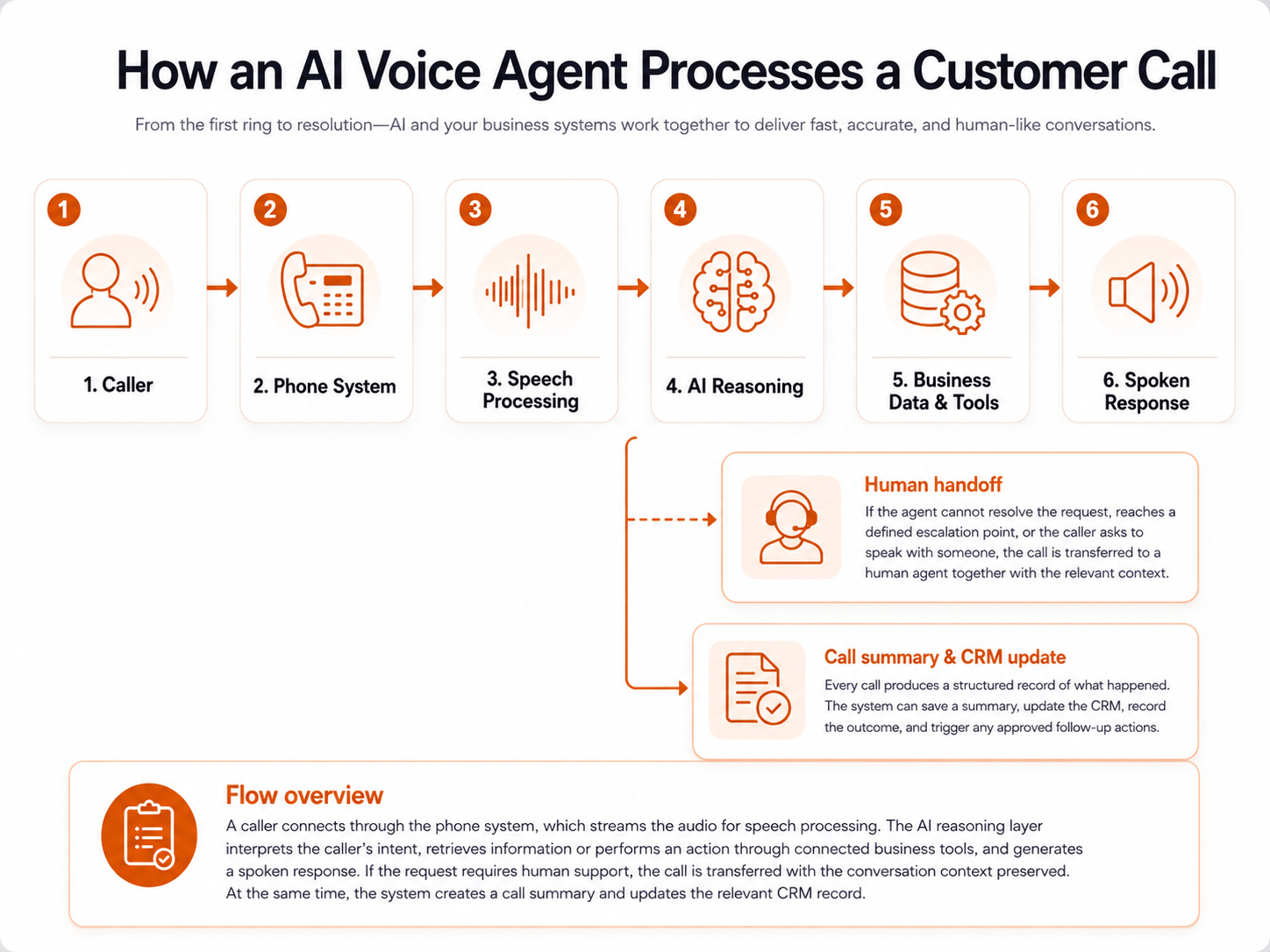
Whether an AI voice agent is answering an inbound call or making an outbound one, the process usually follows the same basic sequence:
- A customer calls the business, or the AI voice agent places an outbound call.
- A telephony platform, such as Twilio Voice, connects the call and streams the audio.
- The system processes the caller’s speech and converts it into a format the AI can understand.
- The AI identifies what the caller is trying to achieve and uses the context already provided during the conversation.
- The agent retrieves approved information or connects to a business system, such as a booking calendar, CRM, or order database.
- It generates a spoken response and delivers it to the caller.
- Once the interaction is complete, the system records the outcome, updates the relevant platform, or transfers the call to a human agent.
In practice, this happens continuously throughout the call. The agent listens, interprets, checks information, responds, and decides what should happen next.
Chained pipelines, speech-to-speech systems, and hybrid models
There are two main ways to power the middle of this process.
A chained pipeline handles speech recognition, language processing, and speech generation as separate stages. The caller’s voice is converted into text, the AI determines how to respond, and the response is then converted back into speech. This setup is flexible and makes it easier to replace individual providers, but every additional stage can introduce a small delay.
A speech-to-speech system processes audio more directly. This is the approach used by products such as OpenAI’s Realtime API for voice applications. It is designed to support faster responses, more natural turn-taking, and interruptions during the conversation.
Many production systems combine both approaches. They may use direct audio processing for the conversation itself while relying on separate services for transcription, analytics, compliance, or call summaries.
The underlying architecture may sound like a technical detail, but it has a noticeable effect on the customer experience and operating cost. It influences:
- Response time: how quickly the agent answers after the caller finishes speaking.
- Accuracy: how reliably it transcribes and understands the request.
- Turn-taking: whether the conversation flows naturally without awkward pauses or both sides speaking at once.
- Interruptions: whether the caller can cut in, correct the agent, or change direction mid-sentence.
- Accents and background noise: how well the system performs outside ideal recording conditions.
- Integration reliability: whether connected systems respond consistently under real call volumes.
- Operating cost: how telephony, model usage, and call duration scale as volume increases.
- Monitoring and troubleshooting: how easily a team can review a call and understand what went wrong.
Where AI Voice Agents Work and Where They Do Not
Benefits, Costs, and Risks Business Owners Should Consider
Is Your Business Ready for an AI Voice Agent?
FAQ
No. A traditional IVR routes callers through a fixed menu of key presses or phrases and can't handle requests phrased differently than expected. An AI voice agent understands open-ended speech, holds context across the conversation, and retrieves information or takes action through business integrations.
Yes. The same technology that answers inbound calls can place outbound ones, for reminders, confirmations, or lead follow-up. Outbound use carries extra responsibility: businesses must follow applicable consent and calling-time rules — in the US, the FTC's Telemarketing Sales Rule is a relevant starting point — before launching an automated outbound program.
Yes, and they should be built to do this reliably. A well-designed AI voice agent recognizes when a request is outside its scope — an angry caller, an unusual case, a high-stakes decision — and transfers the call, ideally passing along context so the caller doesn't repeat themselves.
There's no fixed price, because cost depends on call volume, integration complexity, languages supported, and whether it's a template deployment or a custom build. Costs generally include a build or setup phase plus ongoing per-minute usage for telephony and AI processing. Ask any vendor for a full cost breakdown, not just a headline rate.